

WordPress SEO Services Case Study: Proven Tactics That Drove a Staggering 76% Traffic Surge
Prios Personal GmbH had a working WordPress site and a catalogue of real jobs posted every day. Their wordpress seo services problem was not visible from the front end — it was structural. The jobs lived in a third-party recruitment platform called Percy. WordPress showed them via an embedded feed. Google saw none of them. Every job posted was invisible to search.
This case study covers what we built, why we built it that way, and what the Search Console data shows after 45 days.
Table of Contents
- The Client: Prios Personal GmbH
- Why a Live Job Board Had Zero Job Traffic
- The Solution: Custom Plugin + Job Schema
- Technical Implementation
- Location Pages: A Second SEO Layer
- Results: What the Data Shows
- Independent Analytics and Floating CTAs
- WordPress SEO Agency vs. Freelancer: Which Do You Need?
- FAQ
The Client: Prios Personal GmbH
Prios Personal is a German employment agency (Zeitarbeit) operating across Baden-Württemberg — covering Villingen-Schwenningen, Tuttlingen, Nagold, Donaueschingen, Rottweil, and Friedrichshafen. They place workers in production, logistics, and manufacturing roles and post new vacancies daily.
Their business depends on two things: employer trust built over years, and candidate visibility for people actively searching for jobs in specific towns. The second one was broken.
Why a Live Job Board Had Zero Job Traffic
The root cause was architecture. Prios managed job listings through Percy, a third-party recruitment platform. Percy handled the employer workflow well — job creation, candidate management, application routing. But the jobs lived in Percy, not in WordPress. They appeared on the website via a rendered feed. No WordPress post. No crawlable URL. No page Google could index.
The Search Console data from February 2026 makes this visible. The site was getting 10–39 clicks per day, almost entirely from branded queries — “prios personal gmbh”, “prios villingen”, “prios nagold”. People who already knew the company were finding it. No one else was.
Searches like jobs tuttlingen, produktionsmitarbeiter, stellenangebote nagold, leihfirma villingen — high-intent queries from people actively looking for work in the exact towns Prios operates in — returned nothing from prios-personal.de. The entire daily job catalogue was generating zero organic traffic from competitive searches.
The Solution: Custom Plugin + Job Schema
The brief was clear: get the jobs into WordPress so Google can index them, get them into Google Jobs, and do it without replacing the Percy workflow the client already relies on.
We built a custom WordPress plugin — the TechCreative Percy Sync — that does three things on a schedule:
- Fetches live job listings from Percy’s API
- Creates a WordPress custom post type (CPT) post for each job at
/jobs/[job-slug]/ - Submits a
JobPostingschema block for each new job to Google via the Google Indexing API
This is what technical wordpress seo services look like when the problem is structural. The job data already existed. The gap was getting it in front of Google — and that required code, not keyword edits.
Technical Implementation
Custom Post Type and Schema
Each job post created by the plugin includes:
- A canonical URL Google can crawl:
/jobs/[job-slug]/ JobPostingschema in JSON-LD format: job title, employer name, location, salary range, employment type, posting date, expiry date- City-based taxonomy tags so location archive pages aggregate the right jobs
The schema uses Google’s Indexing API rather than waiting for Googlebot’s next scheduled crawl. When a new job publishes, the plugin fires a POST request to the API immediately. New jobs appear in Google Search — including the Google Jobs carousel — within hours rather than weeks.
Expiry Handling
When a job expires in Percy, the corresponding WordPress post is unpublished and a URL_DELETED notification is sent to the Indexing API. Google removes it from results quickly. This is important — a job board with dead listings for roles that no longer exist is a user experience problem that compounds over time and damages CTR.
Watch Out For: Indexing API Quota
Google’s Indexing API has a daily request quota. Prios posts multiple jobs per day. We staggered submission over rolling time windows so the plugin does not hit the quota ceiling on days when Percy syncs a large batch. If you build this without managing quota, new jobs silently fail to submit — and you will not find out until you notice impressions have plateaued. Check the API response codes, not just the publish status in WordPress.
SEO in WordPress Without a Standard Plugin
This project required seo in wordpress without plugin — at least, without a standard off-the-shelf plugin. RankMath and Yoast handle on-page keyword optimisation well. Neither manages a live Percy API integration or controls the Indexing API submission lifecycle. The custom plugin covers what no general plugin can: scheduled data sync, per-job schema generation, and programmatic Indexing API management at scale.
For a job board posting hundreds of jobs per month, there is no shortcut here. The schema submission has to be automated or it does not happen consistently.
Location Pages: A Second SEO Layer
Beyond individual job posts, the plugin tags each job to its relevant city. WordPress generates archive pages for each location taxonomy term automatically:
/jobs-stellenangebote-donaueschingen/— 113 clicks, 4,606 impressions/jobs-stellenangebote-nagold/— 45 clicks, 1,909 impressions/jobs-stellenangebote-villingen-schwenningen/— 39 clicks, 3,535 impressions/jobs-stellenangebote-tuttlingen/— 47 clicks, 1,696 impressions
These pages serve two purposes. For users: a direct landing point for anyone searching for jobs in a specific town. For Google: a clear site structure showing that prios-personal.de is the authoritative source for staffing in these locations — not just a company homepage with an embedded third-party feed.
We apply the same structured approach to done-for-you WordPress membership and LMS builds — custom development from brief to handover, without the back-and-forth.
Results: What the Data Shows
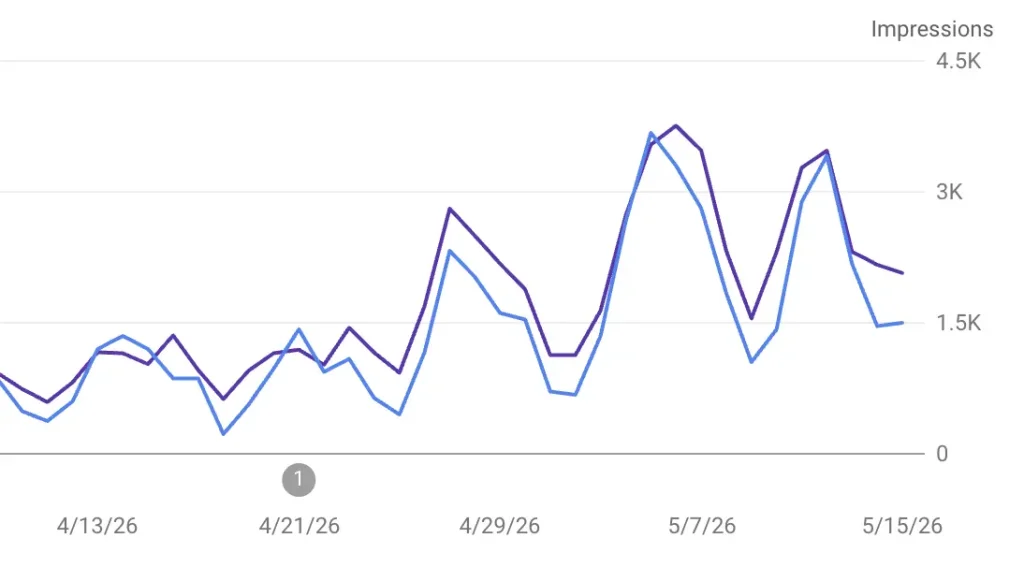
The Search Console data covers 16 February to 15 May 2026 — 89 days. The plugin launched approximately six weeks into that period. The contrast between the first half and the second is direct:
| Metric | Feb 16 – Mar 31 | Apr 1 – May 15 | Change |
|---|---|---|---|
| Total clicks | 1,228 | 1,606 | +31% |
| Total impressions | 44,915 | 71,727 | +60% |
| Average position | 12.7 | 9.4 | +3.3 positions |
| Peak daily clicks | 66 | 98 | +48% |
The acceleration is sharper when comparing the last three weeks (25 April – 15 May) against the first three weeks (16 February – 8 March):
- First 3 weeks: 606 clicks
- Last 3 weeks: 1,068 clicks
- Growth: 76%
The peak days — 98 clicks on 5 May, 91 clicks on 12 May — come from a combination of Google Jobs placements for individual job posts and the city-specific pages beginning to rank for non-branded local job searches.
[SCREENSHOT: Google Search Console performance graph showing Feb–May 2026 click and impression growth]
The Queries That Did Not Exist Before
Branded traffic (people searching for “prios personal” directly) was already there. The shift is in the non-branded queries that now appear in the console for the first time:
- stellenangebote tuttlingen — 12 clicks, 400 impressions
- produktionsmitarbeiter — 8 clicks, 553 impressions
- leihfirma villingen — 11 clicks, 339 impressions
- jobs tuttlingen — 10 clicks, 622 impressions
- jobs nagold — 9 clicks, 356 impressions
These numbers are not large in isolation. Together, they represent job seekers who found Prios for the first time through a search — people who had never heard of the company and would not have found them without the plugin.
According to Search Engine Land, Google Jobs listings typically show above standard organic results for job-related queries — so structured data schema for job posts gives a placement advantage that standard on-page SEO cannot match on its own.
Independent Analytics and Floating CTAs
After the initial launch, we added floating contact buttons on all job pages, each with UTM parameters specific to the Google Jobs traffic source. This separated job-page enquiries from general organic web traffic in the analytics.
The reason: the client’s marketing team needed to show internal stakeholders that the traffic increase was producing actual candidate enquiries — not just impressions. A 60% impression increase is hard to defend to a board without a conversion number attached to it.
We also added a lightweight WordPress admin dashboard showing Indexing API submission activity for the last 7 days: jobs submitted, submission errors, and quota remaining. This was outside the original scope. The client asked “how do we know this is still running?” — a fair question for any automated process. The answer is a visible status screen they can check without developer access.
WordPress SEO Agency vs. Freelancer: Which Do You Need?
A wordpress seo freelancer can handle most on-page SEO work: title tags, meta descriptions, keyword placement, RankMath setup, basic schema markup. If your requirement is content optimisation on a stable site with existing infrastructure, a freelancer covers it.
When your requirement is a custom plugin that integrates with a third-party API, manages structured data generation at scale, handles Indexing API lifecycle (submission and deletion), and includes analytics instrumentation — that is development work, not just SEO work. A wordpress seo agency with in-house developers handles both in the same engagement without you managing two separate contractors.
For location-specific work: if you are looking for a wordpress seo company or affordable wordpress seo agency in a specific geography, TechCreative operates remotely and takes on international clients. The prios-personal.de work was done for a German client from the UK, entirely remote.
The decision framework:
- On-page SEO, content, RankMath configuration → a freelancer or wordpress seo consultant is sufficient
- Custom plugin development + API integration + schema at scale → you need an agency with WordPress developers
- Ongoing SEO management plus technical development → an agency on retainer works better than a freelancer for each task separately
What makes an affordable wordpress seo agency worth the cost is the compound return. The Percy Sync plugin was a one-time development investment. Every job post published after that goes directly to Google Jobs automatically, at no additional cost. The alternative — paying for job board advertising placements to achieve the same candidate reach — runs indefinitely.
Ready to fix your WordPress SEO?
Tell us what you’re working on — we’ll assess the gap and tell you exactly what it takes to close it.
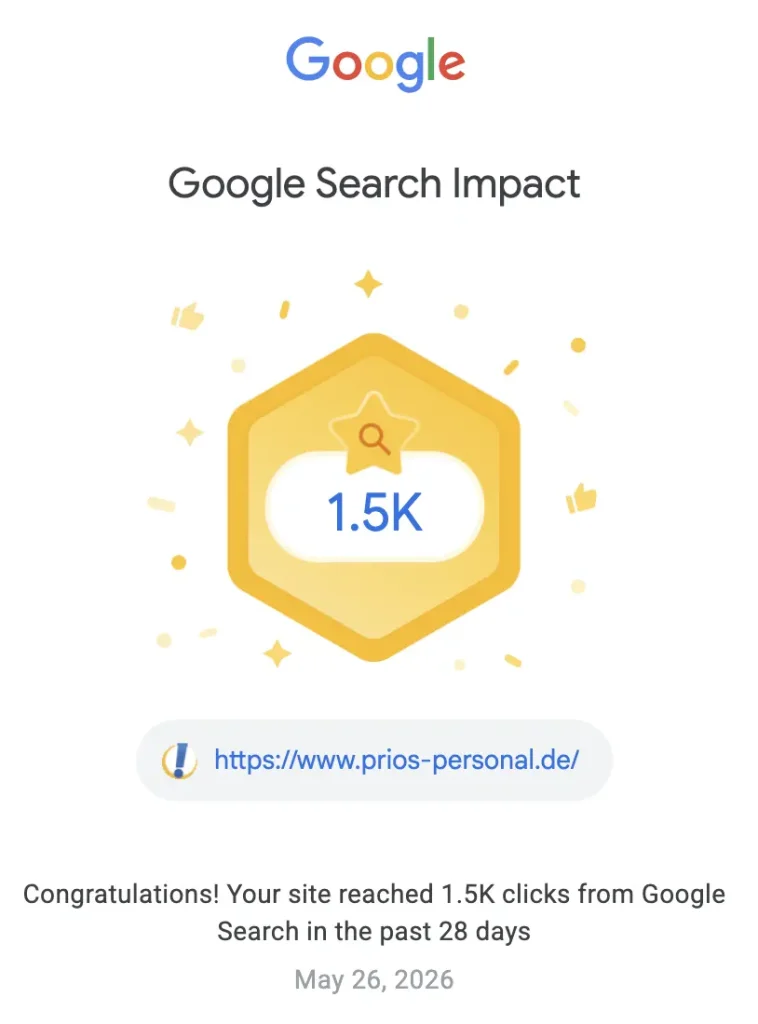
28 May 2026 Update
The site just unlocked a new badge on Google as it reached over 1500 click in the past 28 days
FAQ: WordPress SEO Services
What do wordpress seo services typically include?
At the technical end: site audits, structured data implementation, Core Web Vitals work, and API integrations that get content in front of Google. At the content end: keyword research, on-page optimisation, and meta configuration. For sites with third-party data sources or custom post types, it often includes plugin development to bridge the gap between where data lives and where Google can find it.
How long does it take to see results from a wordpress seo company?
It depends on the mechanism. For prios-personal.de, the Indexing API submissions produced visible impressions within a week of the first job posts going live. Click growth followed 4–6 weeks later as positions settled. Standard on-page content changes take 8–12 weeks to show measurable position movement — Google has to recrawl, re-evaluate, and re-rank. Schema via the Indexing API is faster because you are telling Google directly that a URL exists, rather than waiting for discovery.
Is it possible to do seo in wordpress without plugin?
Yes, for a site with a small stable page count. You can add JSON-LD schema in your theme files, write clean title and meta tags in functions.php, and submit sitemaps to Search Console manually. For a job board generating hundreds of new posts per month, manual management is not sustainable. The schema submission alone — one API call per post, with error handling, quota management, and expiry cleanup — requires automation. That automation is the plugin.
What is the difference between a wordpress seo consultant and a wordpress seo agency?
A wordpress seo consultant diagnoses and recommends — they tell you what to fix and may oversee implementation by others. A wordpress seo agency both diagnoses and implements, including any development work. For projects that require SEO strategy and WordPress plugin development in the same engagement, the agency structure avoids the coordination overhead of managing a consultant and a separate developer in parallel.
Does google jobs schema work for non-english job boards?
Yes. Google Jobs operates in German and supports JobPosting schema in any language. The structured data fields — title, description, hiringOrganization, jobLocation, baseSalary — are language-agnostic. The content of those fields can be in German. Prios-personal.de’s job posts are entirely in German, and they appear in German Google Jobs results.